Connectors and brackets
102 items · 3 groups
This category covers metal connectors for timber construction: corner brackets, ribbed (reinforced) angles, perforated connector plates, external and internal joist hangers, perforated mounting strap and post bases. There are 102 items in 12 product lines, mostly galvanised steel, used in roofing, framing, decking and furniture work. Sizes for each line are in the tables below.
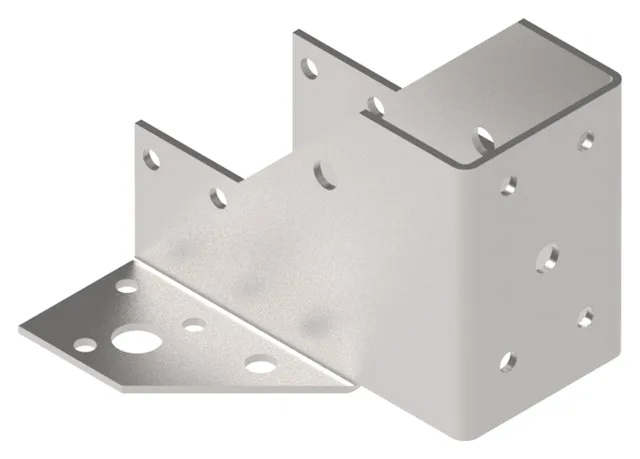 Joist hangers and post bases
31 items
Boxes from 8.09 €
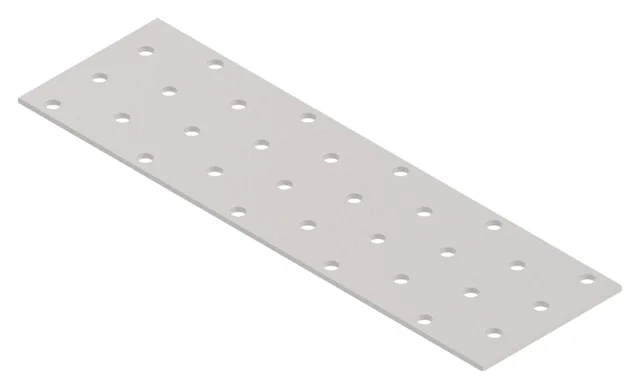 Plates and straps
33 items
Boxes from 3.49 €
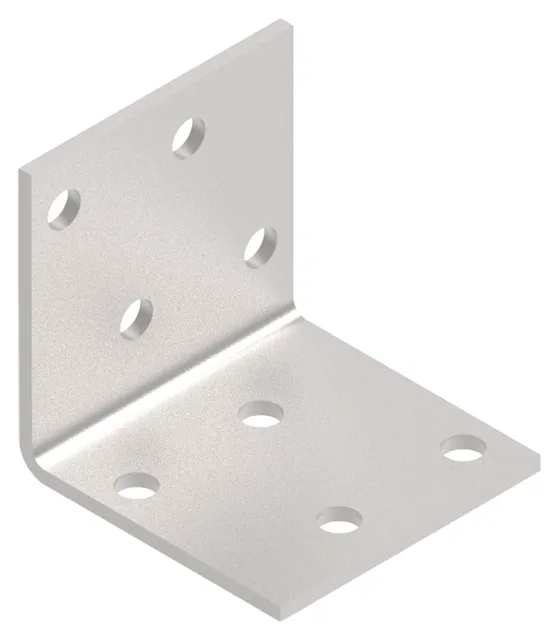 Angle brackets
38 items
Boxes from 4.39 €
- Venipak courier — 4.99 € up to 150 €, 9.99 € up to 300 €To your door across Latvia. Shipped within 1–2 working days after payment.
- From 300 € — free deliveryCourier to your door or the supplier’s transport to your site — the day is agreed by phone.
- Invoice for companiesWith your details and VAT number, automatically. Payment by bank transfer.
- 14-day right of withdrawalYou can withdraw from the purchase within 14 days.
What the category covers and which line to use
Corner brackets join members at a right angle, for example a beam to a post or a timber to a wall. They come in a 2 mm line and a 2.5 mm line with large holes. Where a joint needs more stiffness, use ribbed angles, because the rib stops the bracket from opening up. Furniture angles suit light jobs such as shelves, frames and carcasses.
Joist hangers carry a joist that meets another beam or a wall. External hangers have their fixing flanges bent outwards. Internal hangers have them turned inwards, which helps where there is little room at the sides. Perforated plates tie members together in one plane. Mounting strap is used for diagonal bracing and for tying down roof timbers. Concrete-in post bases are set into the footing under a fence, carport or pergola post. Adjustable post bases, including those on a threaded rod, let you level decks and canopies.
Material and coating
Most items are galvanised steel. The zinc coating protects the steel indoors and under cover. In permanently damp spots, or in contact with treated timber, check the joints more often.
Choosing size and fixings
Choose the joist hanger width to match the timber section, and choose angles and plates to suit the size of the parts being joined. In timber they are usually fixed with connector nails or connector screws in all the intended holes, and in concrete with anchors. The capacity of a joint depends on the base material, edge distance, number of fixings and the designer's calculation.