Plates and straps
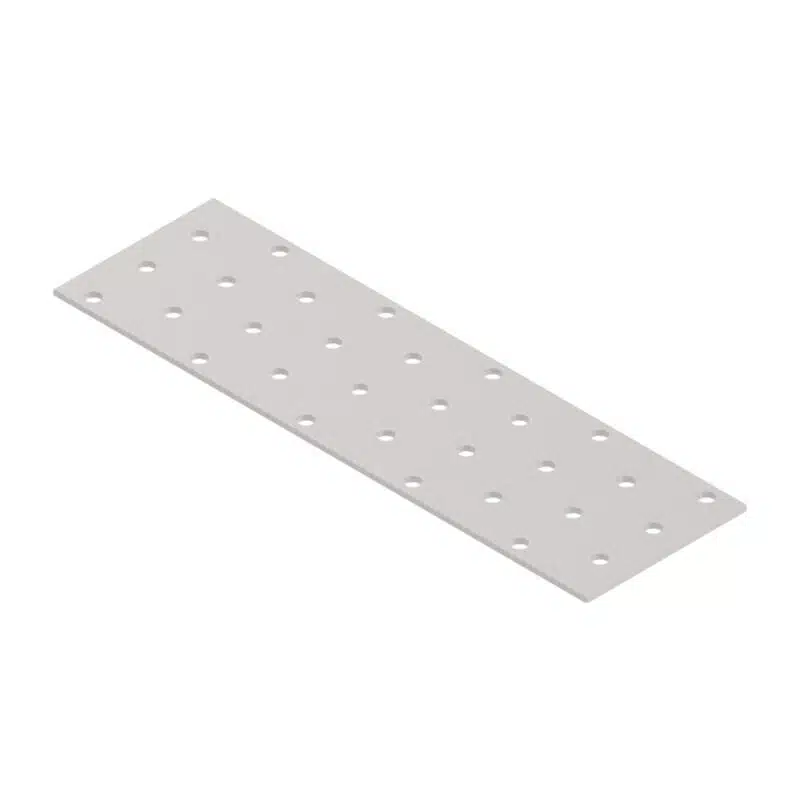
Perforated nail plates. 33 items — box and piece prices in one list.
This category covers perforated connector plates and mounting straps for joining and fixing timber structures and hanging building services – 33 items in three product lines. Plates are used on beams, rafters and trusses, light straps for hanging pipes and cables, heavy straps for wind bracing and rafter tie-downs. Sizes are listed in the tables below.
Common specs
- Per box
- 1–250 pcs
- Perforated nail plate 20 × 80 × 2 mm, galvanisedP-020X08039.39 €250 pcs · 0.158 €/pc
- Perforated nail plate 40 × 80 × 2 mm, galvanisedP-040X0803.49 €20 pcs · 0.175 €/pc
- Perforated nail plate 40 × 100 × 2 mm, galvanisedP-040X1004.29 €20 pcs · 0.215 €/pc
- Perforated nail plate 40 × 120 × 2 mm, galvanisedP-040X1205.19 €20 pcs · 0.260 €/pc
- Perforated nail plate 40 × 140 × 2 mm, galvanisedP-040X14040.19 €100 pcs · 0.402 €/pc
- Perforated nail plate 40 × 160 × 2 mm, galvanisedP-040X1606.79 €20 pcs · 0.340 €/pc
- Perforated nail plate 50 × 160 × 2 mm, galvanisedP-050X16053.69 €100 pcs · 0.537 €/pc
- Perforated nail plate 50 × 200 × 2 mm, galvanisedP-050X20065.89 €100 pcs · 0.659 €/pc
- Perforated nail plate 60 × 120 × 2 mm, galvanisedP-060X1207.69 €20 pcs · 0.385 €/pc
- Perforated nail plate 60 × 140 × 2 mm, galvanisedP-060X1408.99 €20 pcs · 0.450 €/pc
- Perforated nail plate 60 × 160 × 2 mm, galvanisedP-060X1609.19 €20 pcs · 0.459 €/pc
- Perforated nail plate 60 × 200 × 2 mm, galvanisedP-060X20011.49 €20 pcs · 0.575 €/pc
- Perforated nail plate 60 × 240 × 2 mm, galvanisedP-060X24015.89 €20 pcs · 0.795 €/pc
- Perforated nail plate 60 × 300 × 2 mm, galvanisedP-060X30019.29 €20 pcs · 0.964 €/pc
- Perforated nail plate 80 × 200 × 2 mm, galvanisedP-080X20015.69 €20 pcs · 0.785 €/pc
- Perforated nail plate 80 × 240 × 2 mm, galvanisedP-080X24018.99 €20 pcs · 0.949 €/pc
- Perforated nail plate 80 × 300 × 2 mm, galvanisedP-080X30024.29 €20 pcs · 1.21 €/pc
- Perforated nail plate 100 × 140 × 2 mm, galvanisedP-100X14045.09 €50 pcs · 0.902 €/pc
- Perforated nail plate 100 × 160 × 2 mm, galvanisedP-100X16017.09 €20 pcs · 0.855 €/pc
- Perforated nail plate 100 × 200 × 2 mm, galvanisedP-100X2009.19 €10 pcs · 0.919 €/pc
- Perforated nail plate 100 × 240 × 2 mm, galvanisedP-100X24025.09 €20 pcs · 1.25 €/pc
- Perforated nail plate 100 × 300 × 2 mm, galvanisedP-100X30015.69 €10 pcs · 1.57 €/pc
- Perforated nail plate 120 × 200 × 2 mm, galvanisedP-120X20012.79 €10 pcs · 1.28 €/pc
- Perforated nail plate 120 × 240 × 2 mm, galvanisedP-120X24014.89 €10 pcs · 1.49 €/pc
- Perforated nail plate 120 × 300 × 2 mm, galvanisedP-120X30018.79 €10 pcs · 1.88 €/pc
- Perforated nail plate 200 × 300 × 2 mm, galvanisedP-200X30038.69 €10 pcs · 3.87 €/pc
Price per box, incl. VAT
- Perforated mounting strap 17 × 0.6 mm, 25 m, holes 6.5 × 12 mmML-17 M618.99 €
- Perforated mounting strap 17 × 0.6 mm, 25 m, holes Ø 8.5 mmML-17 M818.99 €
- Perforated mounting strap 20 × 0.75 mm, 25 m, holes Ø 8.5 mmML-20 M822.09 €
- Perforated mounting strap 25 × 0.75 mm, 25 m, holes Ø 8.5 mmML-25 M826.39 €
- Perforated mounting strap 25 × 1.5 mm, 25 mml-2529.89 €
- Perforated mounting strap 40 × 2 mm, 25 mml-4050.49 €
- Perforated mounting strap 60 × 2 mm, 25 mml-6096.29 €
Which line for which job
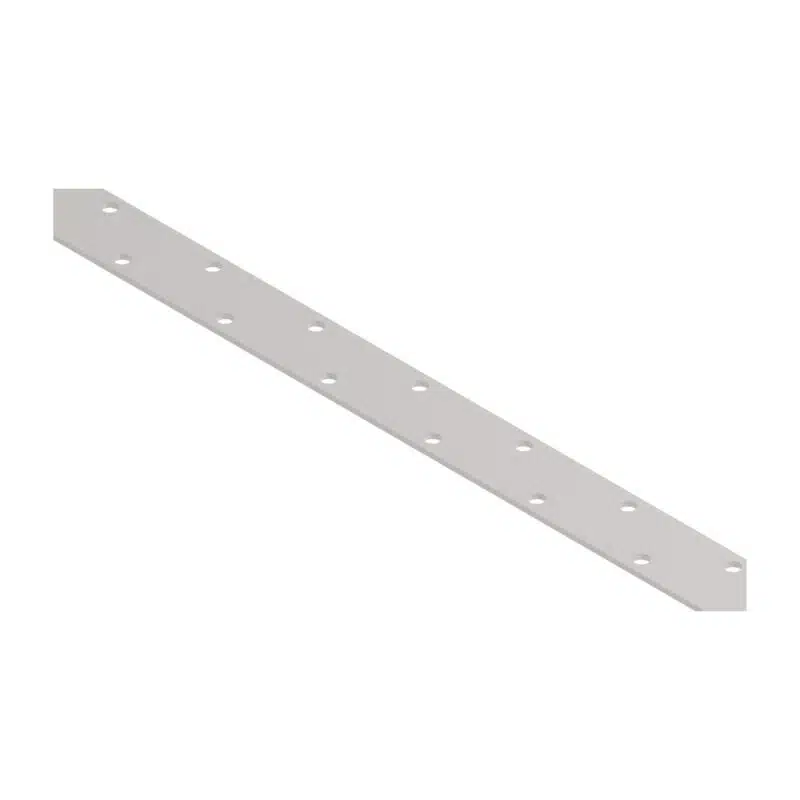
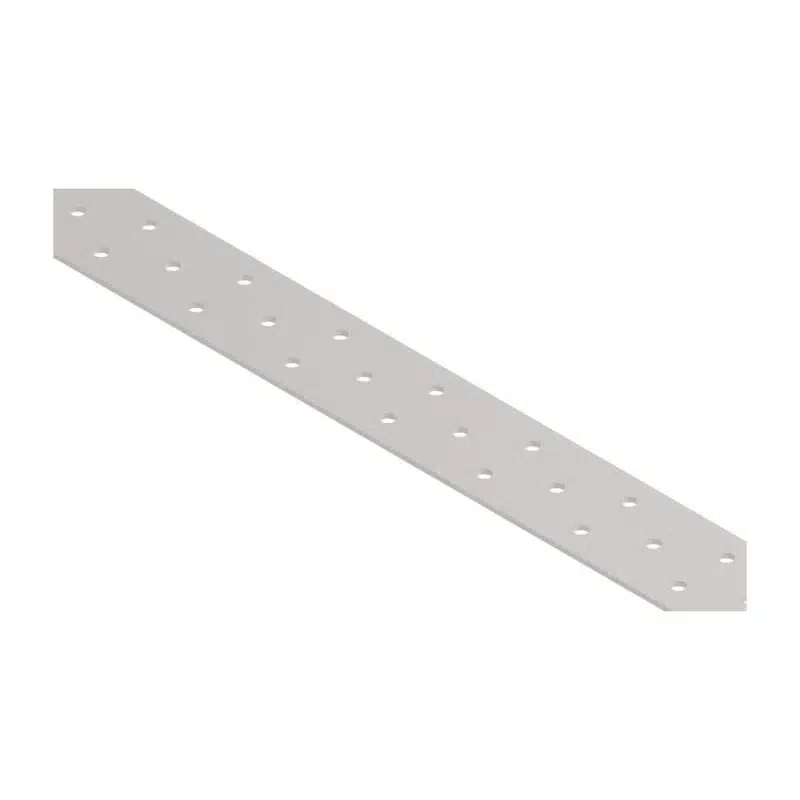
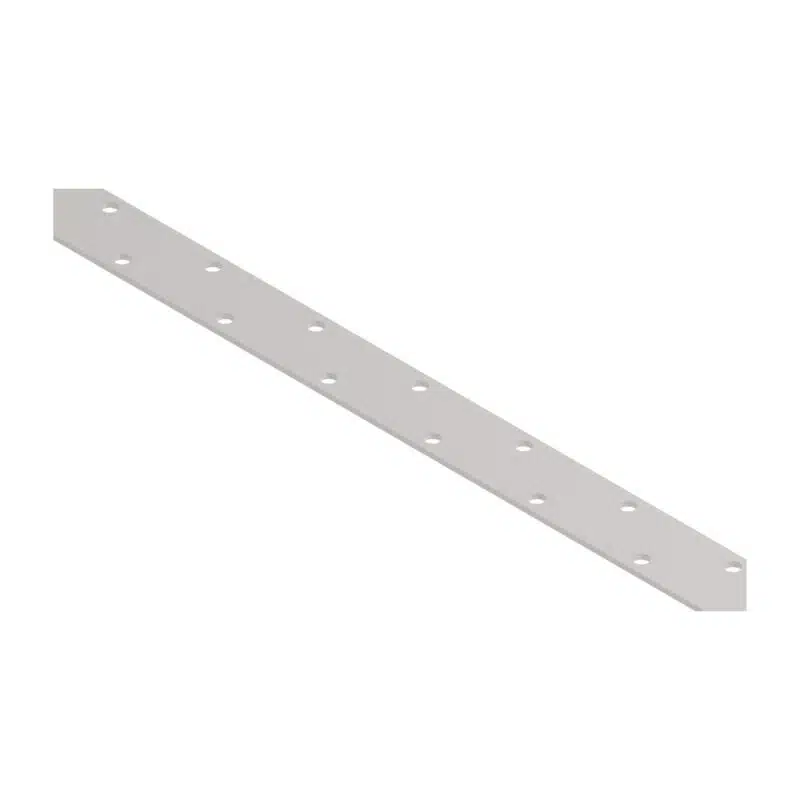
Perforated connector plates (26 sizes) are used for butt joints between timber members. Typical jobs are extending beams, connecting rafter and truss nodes and tying frame studs to plates. The plate is normally fitted on both sides of the joint and fixed through the perforations with anchor nails or connector screws.
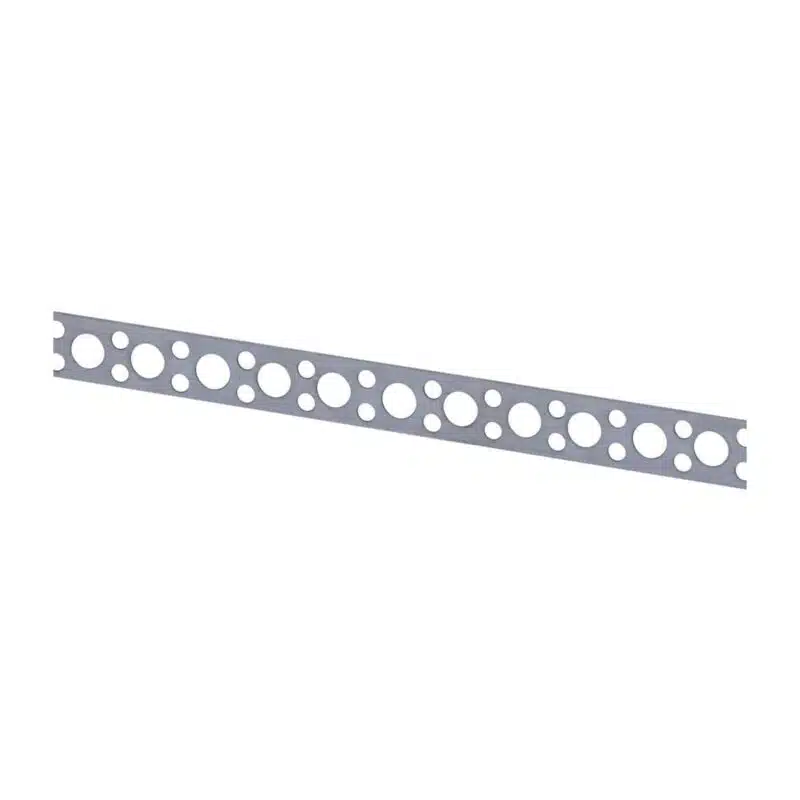
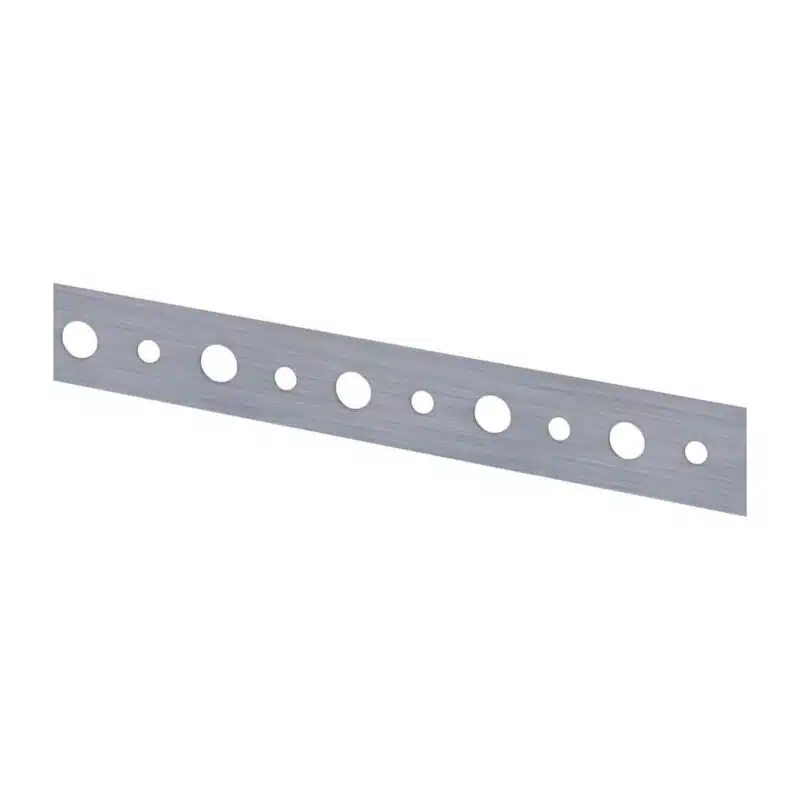
Mounting straps 17–25 mm are light perforated straps supplied in rolls, for example 17 × 0.6 mm, 25 m, with 6.5 × 12 mm holes. They suit hanging pipes, ducts and cables, and light tie-downs. Heavy mounting straps 25–60 mm, such as 25 × 1.5 mm, are chosen for diagonal wind bracing in roofs, tying rafters to the wall plate and other tension ties.
Material and coating
The connector plates are made of zinc-coated steel. They are intended for indoor use and areas sheltered from rain, such as roof structures. Check the material and coating of each strap in the item description. Use nails and screws with the same or an equivalent coating so that the joint does not suffer from contact corrosion.
Choosing the size
Choose plate width and length to match the cross-section of the members being joined and the number of fixings needed on each side of the joint. For straps, look at width, thickness and hole size, which must suit your nails or screws. The capacity of any joint depends on the base material, edge distance, number of fixings and the designer's calculation, so follow the structural design for load-bearing connections.