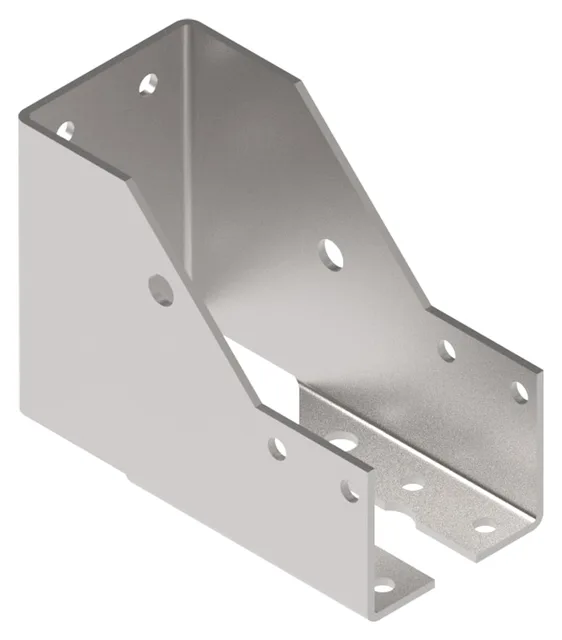
Concealed joist hangers, galvanised
7 items · Boxes from 14.59 €
Concealed joist hangers are galvanised steel connectors. They fix a joist or beam to another beam, joist or wall at a right angle. The fixing flanges point inwards, so the hanger does not stick out beyond the timber and the joint looks tidy. Use them for floor and decking joists, floor beams, roof and frame structures.
- Per box
- 10–56 pcs
| Size | Code | Pack | Box price incl. VAT | Price per piece | Availability | Order | |
|---|---|---|---|---|---|---|---|
| 45 × 97 × 2 mm | IBZ-045X097 | 10 pcs | 14.59 € | 1.46 €/pc | In stock | 10 pcs · In stock · 1.46 €/pc | |
| 51 × 105 × 2 mm | IBZ-051X105 | 56 pcs | 91.29 € | 1.63 €/pc | In stock | 56 pcs · In stock · 1.63 €/pc | |
| 76 × 122 × 2 mm | IBZ-076X122 | 10 pcs | 15.99 € | 1.60 €/pc | In stock | 10 pcs · In stock · 1.60 €/pc | |
| 80 × 120 × 2 mm | IBZ-080X120 | 10 pcs | 18.89 € | 1.89 €/pc | In stock | 10 pcs · In stock · 1.89 €/pc | |
| 90 × 145 × 2 mm | IBZ-090X145 | 32 pcs | 65.99 € | 2.06 €/pc | In stock | 32 pcs · In stock · 2.06 €/pc | |
| 100 × 140 × 2 mm | IBZ-100X140 | 10 pcs | 21.89 € | 2.19 €/pc | In stock | 10 pcs · In stock · 2.19 €/pc | |
| 140 × 180 × 2 mm | IBZ-140X180 | 10 pcs | 31.89 € | 3.19 €/pc | In stock | 10 pcs · In stock · 3.19 €/pc |
Price per box, incl. VAT
Where concealed hangers are used
A concealed joist hanger joins two timber members at a right angle or fixes a joist to a wall. Typical uses are floor and decking joists, floor beams, roof and frame structures, pergolas and shelters. The joist end sits in the hanger, and the load passes through the fixings into the supporting member. You do not have to rely only on screws driven into end grain.
On a standard joist hanger the flanges face outwards. On a concealed hanger they face inwards and sit behind the joist end. The hanger is barely visible from outside and takes up no space at the sides of the joist. That makes it the choice for visible structures and for joints close to a corner or next to another member. Where looks and space do not matter, standard external-flange hangers work too.
Material and coating
The hangers are made from 2 mm steel with a zinc coating. Galvanising protects against corrosion indoors, under cover and in dry, ventilated structures. Steel thickness is the same across the range; only the timber size each hanger fits changes. Outdoors and in damp locations, the fixings must also suit the conditions, so use C3-coated screws.
Choosing the size
Sizes are given as timber width × hanger height. For example, 45 × 97 mm means a hanger for timber 45 mm wide, with a height of 97 mm. The range runs from 45 × 97 to 140 × 180 mm, covering everything from joists to heavy beams. The hanger width should match the timber width so the joist sits snugly without gaps. The joist should be at least as deep as the hanger.
Load capacity is not a single figure. It depends on:
- the supporting material: timber, concrete or masonry;
- the type and number of fixings and how many holes are filled;
- the distance to the edge and end of the member;
- the size and direction of the load in the structure.
For structural work, the hanger size and number of fixings should come from the designer's calculation.
Fitting tips
Fix the hanger to the supporting beam, joist or wall first, checking height and level. Then drop the joist in and fix it through the side holes. The joist end should bear on the hanger seat without a gap. In timber, use bracket screws 5 × 40 mm or anchor nails 4 × 40 mm driven with a nailer. On concrete or masonry, use anchors made for that base. Unless the design says otherwise, fill all the fixing holes. Hangers are sold in packs. Pack quantity depends on the size and is shown in the table, and the price is per pack.
Frequently asked questions
What is the difference between a concealed and a standard joist hanger?
A concealed hanger has its fixing flanges turned inwards, behind the joist end. It does not project beyond the timber and is barely visible. A standard hanger has outward flanges that need space at the sides. Choose concealed hangers for visible joints and positions close to a corner.
Which screws or nails should I use?
In timber, use bracket screws 5 × 40 mm or anchor nails 4 × 40 mm with a nailer. On concrete or masonry, you need anchors designed for that base. Outdoors and in damp conditions, use C3-coated screws.
Can galvanised hangers be used on a deck?
Yes, they are used for decking joists, pergolas and shelters. The zinc coating protects against corrosion, but outdoors the fixings must also be suitable, such as C3-coated screws. Keep the structure ventilated so water does not collect at the joint.
How much load can a hanger take?
That depends on the supporting material, the type and number of fixings, the edge distance and the direction of load. There is no single figure for every case. For structural work, a designer should specify the hanger size and number of fixings.
Whole category «Joist hangers and post bases»
- Venipak courier — 4.99 € up to 150 €, 9.99 € up to 300 €To your door across Latvia. Shipped within 1–2 working days after payment.
- From 300 € — free deliveryCourier to your door or the supplier’s transport to your site — the day is agreed by phone.
- Invoice for companiesWith your details and VAT number, automatically. Payment by bank transfer.
- 14-day right of withdrawalYou can withdraw from the purchase within 14 days.