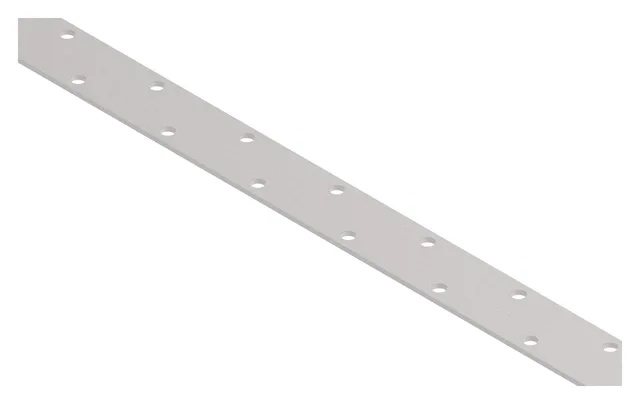
Heavy perforated mounting straps 25–60 mm
3 items · From 29.89 €
Heavy perforated mounting straps 25–60 mm wide and 1.5–2 mm thick, supplied in 25 m rolls. They are used to reinforce timber joints, for wind and diagonal bracing, and for hanging pipes, cables and ducts. Cut the strap to the length you need and fix it through the holes with anchor nails or screws.
| Size | Code | Price incl. VAT | Availability | Order | |
|---|---|---|---|---|---|
| 25 × 1.5 mm | ml-25 | 29.89 € | In stock | In stock | |
| 40 × 2 mm | ml-40 | 50.49 € | In stock | In stock | |
| 60 × 2 mm | ml-60 | 96.29 € | In stock | In stock |
Price per box, incl. VAT
What perforated mounting strap is used for
Perforated mounting strap is a metal strip on a roll with evenly spaced holes. You cut it to length and fix it to the structure with anchor nails or screws, using whichever holes suit the spot. This line covers the heavier straps – 1.5 and 2 mm thick – so they are meant for timber frames and joints where the strap has to carry load, not just hold something in place.
- wind bracing and cross ties in roof and wall frames;
- reinforcing connections between rafters, joists, beams and studs;
- hanging pipes, cables and ducts;
- strengthening existing joints during repairs without taking the structure apart.
Choosing width and thickness
The narrowest strap, 1.5 mm thick, is the all-round choice for wind bracing, cross ties and reinforcing joints. The wider straps are 2 mm thick: they take more fixings and are chosen for heavier beams, rafters and joints where the strap has to transfer a larger force.
The capacity of a connection does not depend on the strap alone. It is affected by the base material and the condition of the timber, the edge distance, the number and type of fixings, and how the strap is loaded in that particular joint. For structural joints, the strap size and number of fixings should come from the designer's calculation.
Fitting tips
Cut the strap with an angle grinder or heavy-duty tin snips and deburr the cut edge. Suitable fixings are bracket screws 5 × 40 mm or anchor nails 4 × 40 mm, which are quick to drive with a nailer. Spread the fixings evenly on both sides of the joint and keep a sensible distance from the timber edge so the wood does not split. For wind bracing and cross ties, pull the strap tight before final fixing so it does not sag.
One 25 m roll gives, for example, 50 ties of 0.5 m or 25 ties of 1 m, which makes it easy to work out quantities for a larger job.
Outdoors and in damp conditions
Where the strap is used outdoors, in an unventilated loft or anywhere else damp, choose C3-coated screws. Avoid leaving the strap in constant contact with standing water or wet timber, and after fitting check that every fixing is fully driven home.
Frequently asked questions
How do I cut the strap to length?
The thinnest strap can be cut with heavy-duty tin snips, while the wider 2 mm straps are easier to cut with an angle grinder. Cut between the holes and deburr the sharp edges so you do not cut yourself during fitting.
What fixings should I use?
Bracket screws 5 × 40 mm or anchor nails 4 × 40 mm driven with a nailer are suitable. Fix through the strap holes on both sides of the joint. Outdoors and in damp conditions, use C3-coated screws.
How many ties can I get from one roll?
Each roll holds 25 m of strap. That gives, for example, 50 ties of 0.5 m or 25 ties of 1 m. When working out quantities, allow a little extra for overlaps and offcuts.
How many fixings does one joint need?
There is no single figure. Capacity depends on the base material, edge distance, number of fixings and strap size. For structural joints in roofs, floors and frames, follow the project drawings or the designer's calculation.
Whole category «Plates and straps»
- Venipak courier — 4.99 € up to 150 €, 9.99 € up to 300 €To your door across Latvia. Shipped within 1–2 working days after payment.
- From 300 € — free deliveryCourier to your door or the supplier’s transport to your site — the day is agreed by phone.
- Invoice for companiesWith your details and VAT number, automatically. Payment by bank transfer.
- 14-day right of withdrawalYou can withdraw from the purchase within 14 days.