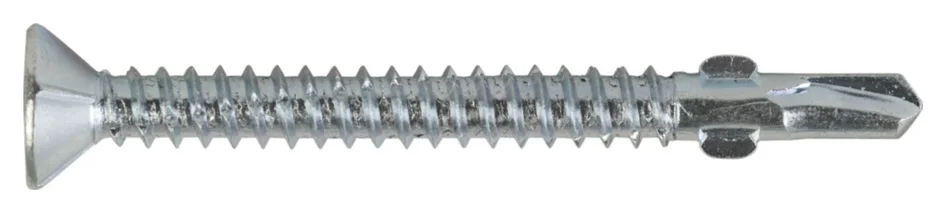
Self-drilling screws for fixing timber to steel
11 sizes · 4.8 × 32 – 6.3 × 85 mm · Boxes from 12.29 €
EASY-FIX self-drilling screws fix timber battens, boards and sheets to steel sections, beams and frames without pre-drilling. The drill point cuts through the steel, the wings ream a wider hole in the timber and the thread then pulls into the metal. The range covers diameters from 4.8 to 6.3 mm and lengths from 32 to 85 mm.
- Brand
- EASY-FIX
- Drive
- TX 25
- Diameters d
- 4.8 · 5.5 · 6.3 mm
- Lengths L
- 32–85 mm
- Per box
- 100–500 pcs
| Size | Code | Pack | Box price incl. VAT | Price per piece | Availability | Order | |
|---|---|---|---|---|---|---|---|
| 4.8 × 32 mm | EASY-S19-048X32 | 500 pcs | 19.19 € | 0.038 €/pc | In stock | 500 pcs · In stock · 0.038 €/pc | |
| 4.8 × 38 mm | EASY-S19-048X38 | 500 pcs | 19.99 € | 0.040 €/pc | In stock | 500 pcs · In stock · 0.040 €/pc | |
| 4.8 × 45 mm | EASY-S19-048X45 | 500 pcs | 21.69 € | 0.043 €/pc | In stock | 500 pcs · In stock · 0.043 €/pc | |
| 4.8 × 50 mm | EASY-S19-048X50 | 250 pcs | 12.99 € | 0.052 €/pc | In stock | 250 pcs · In stock · 0.052 €/pc | |
| 5.5 × 38 mm | EASY-S19-055X38 | 500 pcs | 30.39 € | 0.061 €/pc | In stock | 500 pcs · In stock · 0.061 €/pc | |
| 5.5 × 45 mm | EASY-S19-055X45 | 250 pcs | 15.99 € | 0.064 €/pc | In stock | 250 pcs · In stock · 0.064 €/pc | |
| 5.5 × 55 mm | EASY-S19-055X55 | 250 pcs | 19.19 € | 0.077 €/pc | In stock | 250 pcs · In stock · 0.077 €/pc | |
| 5.5 × 65 mm | EASY-S19-055X65 | 250 pcs | 22.39 € | 0.090 €/pc | In stock | 250 pcs · In stock · 0.090 €/pc | |
| 6.3 × 60 mm | EASY-S19-063X60 | 100 pcs | 12.29 € | 0.123 €/pc | In stock | 100 pcs · In stock · 0.123 €/pc | |
| 6.3 × 70 mm | EASY-S19-063X70 | 100 pcs | 13.09 € | 0.131 €/pc | In stock | 100 pcs · In stock · 0.131 €/pc | |
| 6.3 × 85 mm | EASY-S19-063X85 | 100 pcs | 16.29 € | 0.163 €/pc | In stock | 100 pcs · In stock · 0.163 €/pc |
Price per box, incl. VAT
Typical uses
These screws are made for jobs where timber has to be fixed to steel. The drill point makes its own hole in the metal, so no separate drilling is needed. One operation replaces both drilling and driving. Common applications:
- timber battens and framing on steel structures;
- floorboards and sheets on steel beams;
- timber cladding and trim on metal sections;
- timber parts of canopies, trailers and hangars on a metal frame.
How the screw works and the head
Behind the drill point are two wings. As they pass through the timber, they ream a hole wider than the thread, so the thread does not grip the wood and lift the board away from the steel. When the wings reach the steel, they usually break off, and the thread pulls into the metal, clamping the timber down. The head is countersunk with a Torx TX 25 recess, which holds the bit well under firm pressure. The screws are zinc-plated. This finish suits dry interiors and covered structures, but it gives only limited corrosion protection in constantly damp or exposed outdoor conditions.
Choosing the size
Two dimensions matter. The first is steel thickness. The Ø 4.8 and 5.5 mm screws drill steel from 1.75 to 4 mm, and the Ø 6.3 mm screws drill steel from 2.5 to 6 mm. If the steel is thicker than stated, the drill point may not get all the way through. The second is timber thickness. The table gives the fixed-material thickness for each size, from 16 to 65 mm across the range. Pick the size whose stated thickness matches your board or sheet. Depending on size, screws come in boxes of 100, 250 or 500.
Load capacity is not a single figure. It depends on steel thickness, timber species and thickness, edge distance, and the number and spacing of fixings. For structural work, the fixing should follow the designer's calculation.
Installation tips
Drive the screws with a variable-speed screwdriver and a TX 25 bit, keeping the screw square to the surface. Apply steady pressure along the axis and avoid full speed, because an overheated drill point dulls quickly. Hammering from an impact driver can damage the drill point, so normal drive mode is the safer choice. Stop when the head sits flush with the timber, as overdriving can strip the thread in the steel. Keep away from board ends to avoid splitting the timber.
Frequently asked questions
Do I need to drill a pilot hole first?
No. The drill point cuts through the steel itself, and the wings widen the hole in the timber. No pilot hole is needed as long as the steel thickness is within the drilling capacity of the chosen diameter: 1.75–4 mm for Ø 4.8 and 5.5 mm, and 2.5–6 mm for Ø 6.3 mm.
Why do the wings break off, and is that normal?
Yes, that is how they are designed to work. The wings are only needed in the timber, to stop the thread lifting the board. When they hit the steel they usually snap off, and the thread pulls into the metal. If they do not break, check that the steel is not thinner than the stated range.
How do I know which length suits my board?
The table lists the fixed-material thickness for each size, from 16 to 65 mm across the range. Measure your timber and choose the screw with a matching value. Also check that the diameter is rated for the thickness of your steel.
Can these screws be used outdoors?
The screws are zinc-plated. They suit dry interiors and structures under a roof. In constant damp or rain, zinc offers only limited corrosion protection, so you should expect rust there or plan for additional protection.
Whole category «Self-drilling screws»
- Venipak courier — 4.99 € up to 150 €, 9.99 € up to 300 €To your door across Latvia. Shipped within 1–2 working days after payment.
- From 300 € — free deliveryCourier to your door or the supplier’s transport to your site — the day is agreed by phone.
- Invoice for companiesWith your details and VAT number, automatically. Payment by bank transfer.
- 14-day right of withdrawalYou can withdraw from the purchase within 14 days.