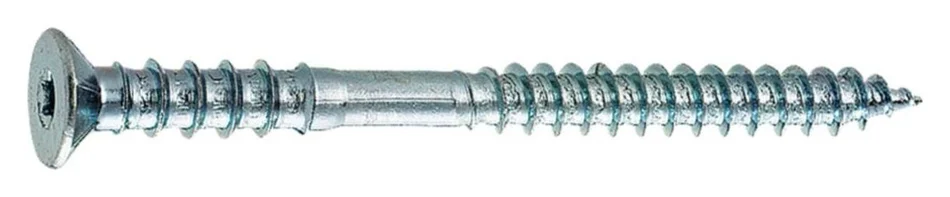
EASY-FIX adjustment wood screws
7 sizes · 6 × 60 – 6 × 120 mm · Boxes from 8.29 €
EASY-FIX adjustment wood screws, 6 mm in diameter, let you set the gap between a batten and the base simply by turning the screw. They are used to level battens, joists and frames on uneven bases without wedges or packers. Lengths run from 60 to 120 mm, adjustment ranges from 0–10 to 0–70 mm, with a Torx TX 25 drive.
- Brand
- EASY-FIX
- Drive
- TX 25
- Diameters d
- 6 mm
- Lengths L
- 60–120 mm
- Per box
- 100–200 pcs
| Size | Code | Pack | Box price incl. VAT | Price per piece | Availability | Order | |
|---|---|---|---|---|---|---|---|
| 60 mm | EASY-REG-060 | 200 pcs | 13.19 € | 0.066 €/pc | In stock | 200 pcs · In stock · 0.066 €/pc | |
| 70 mm | EASY-REG-070 | 100 pcs | 8.29 € | 0.083 €/pc | In stock | 100 pcs · In stock · 0.083 €/pc | |
| 80 mm | EASY-REG-080 | 100 pcs | 9.09 € | 0.091 €/pc | In stock | 100 pcs · In stock · 0.091 €/pc | |
| 90 mm | EASY-REG-090 | 100 pcs | 9.29 € | 0.093 €/pc | In stock | 100 pcs · In stock · 0.093 €/pc | |
| 100 mm | EASY-REG-100 | 100 pcs | 10.89 € | 0.109 €/pc | In stock | 100 pcs · In stock · 0.109 €/pc | |
| 110 mm | EASY-REG-110 | 100 pcs | 12.59 € | 0.126 €/pc | In stock | 100 pcs · In stock · 0.126 €/pc | |
| 120 mm | EASY-REG-120 | 100 pcs | 13.39 € | 0.134 €/pc | In stock | 100 pcs · In stock · 0.134 €/pc |
Price per box, incl. VAT
What adjustment screws are used for
EASY-FIX adjustment screws are the answer when battens, joists or frames have to be levelled on an uneven timber base. The screw holds the part at a set distance from the base, and you change that distance by turning it. This pulls the batten closer or pushes it further out. There is no need for wedges or packers or for planing the base, and the level stays where you set it.
- battens under flooring and wall or ceiling cladding;
- levelling joists on old or uneven beams;
- straightening frame battens before plasterboard or boarding goes on.
Sizes, drive and coating
All screws in the range are 6 mm in diameter and 60 to 120 mm long. The head has a Torx TX 25 recess, which keeps the bit firmly seated when you turn the screw slowly and adjust a millimetre at a time. The screws are zinc-plated, so they are meant for indoor and dry locations. For damp rooms and outdoor work zinc plating is not enough; use fixings with suitable corrosion protection instead. Packs contain 100 or 200 pcs depending on size.
How to choose the length
Length sets the adjustment range. The shortest screw gives 0–10 mm and the longest gives 0–70 mm. The range for each size is shown in the table. Measure the largest gap between batten and base first, then pick the size whose range covers it with a little to spare. If the base is only slightly uneven, there is no point in the longest screw. A shorter one is easier to adjust and less likely to come through a thin base.
The load a joint can carry depends on the timber of the base, edge distance, the number of screws and their spacing. For floors and other loaded structures it should be set by the designer's calculation.
Fitting tips
Fix and adjust the ends of each batten first. Then run a string line or lay a long level along it and adjust the screws in between. Use a TX 25 bit and a driver with torque control at low speed. An impact driver is not suited to fine adjustment. In hardwood and near the edge of a part, pre-drill to avoid splitting. After adjusting, check the level along the full length before fitting the cladding or flooring.
Frequently asked questions
How do I choose the right length?
Measure the largest gap between the batten and the base. Choose a screw whose adjustment range covers that gap with a small margin. The range for each size is listed in the table. Longer screws give a bigger range, from 0–10 mm on the shortest to 0–70 mm on the longest.
Can these screws be used outdoors or in damp rooms?
No. The screws are zinc-plated and intended for indoor and dry locations. For decking, façades and damp rooms, choose fixings with a suitable corrosion-resistant coating, such as C4 outdoor screws.
How many screws do I need per batten?
It depends on the batten section, the load and the base. Screws are usually placed at both ends of the batten and at even spacing in between so it does not sag. For floors and loaded structures, the number and spacing should come from the design or calculation.
Which bit do I need?
Torx TX 25. Use a good bit and a driver with torque control at low speed so you can set the gap accurately. An impact driver is awkward for adjustment because it is hard to stop at exactly the right point.
Whole category «Construction screws»
- Venipak courier — 4.99 € up to 150 €, 9.99 € up to 300 €To your door across Latvia. Shipped within 1–2 working days after payment.
- From 300 € — free deliveryCourier to your door or the supplier’s transport to your site — the day is agreed by phone.
- Invoice for companiesWith your details and VAT number, automatically. Payment by bank transfer.
- 14-day right of withdrawalYou can withdraw from the purchase within 14 days.