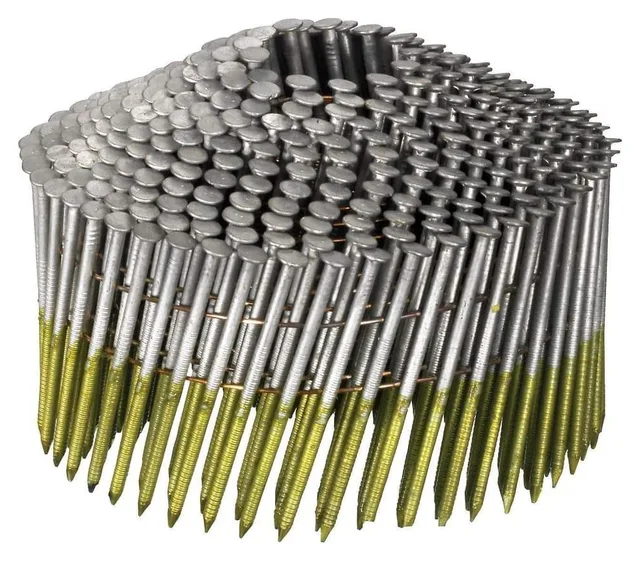
EASY-FIX C3 ring shank coil nails
5 sizes · 2.1 × 45 – 3.1 × 90 mm · Boxes from 25.29 €
EASY-FIX C3 is a line of ring shank nails in 16° coils for coil nailers. The ringed shank grips timber better than a smooth nail, and the C3 coating is intended for moderate corrosion exposure. Lengths from 45 to 90 mm cover everything from sheathing and OSB to timber frame joints.
- Brand
- EASY-FIX
- Coating
- C3
- Angle
- 16°
- Diameters d
- 2.1 · 2.3 · 2.5 · 2.8 · 3.1 mm
- Lengths L
- 45–90 mm
- Per box
- 1 350–4,500 pcs
| Size | Code | Pack | Box price incl. VAT | Price per piece | Availability | Order | |
|---|---|---|---|---|---|---|---|
| 2.1 × 50 mm | EFN-16-C3-50 | 4,500 pcs | 43.69 € | 0.010 €/pc | In stock | 4,500 pcs · In stock · 0.010 €/pc | |
| 2.3 × 45 mm | EFN-16-C3-45 | 3,600 pcs | 38.89 € | 0.011 €/pc | In stock | 3,600 pcs · In stock · 0.011 €/pc | |
| 2.5 × 65 mm | EFN-16-C3-65 | 1,800 pcs | 25.29 € | 0.014 €/pc | In stock | 1,800 pcs · In stock · 0.014 €/pc | |
| 2.8 × 75 mm | EFN-16-C3-75 | 1,500 pcs | 29.89 € | 0.020 €/pc | In stock | 1,500 pcs · In stock · 0.020 €/pc | |
| 3.1 × 90 mm | EFN-16-C3-90 | 1,350 pcs | 36.89 € | 0.027 €/pc | In stock | 1,350 pcs · In stock · 0.027 €/pc |
Price per box, incl. VAT
What they are used for
EASY-FIX C3 ring shank nails come in 16° coils for jobs where you drive a large number of nails and hand nailing would be too slow. Once driven, the rings bite into the wood fibres and hold better than a smooth shank. This means joints are less likely to loosen as the timber dries and moves.
- timber frames and stud partitions;
- sheathing, battens and roof boards;
- OSB and other boards fixed to a frame;
- other carpentry where speed and even nail spacing matter.
These nails are not meant for perforated angles and plates. Those are fixed with anchor nails driven by an anchor nailer, or with connector screws.
C3 coating and 16° coils
The nails have a coating for corrosivity category C3, which means moderate exposure. Typical examples are unheated buildings with changing humidity, battens under roofing, and framing behind cladding. In dry, heated interiors, uncoated nails are enough. If the nails will be permanently wet, near the sea or in contact with aggressive substances, choose fixings with higher corrosion resistance.
The nails are collated in 16° coils. A coil holds a lot of nails, so you reload less often than with strip magazines. The collation type and angle must match your nailer: coils will not work in a 34° strip nailer, and strips will not work in a coil nailer.
Choosing length and diameter
The line runs from 45 to 90 mm, and the shank gets thicker as the length increases. As a guide, 45–50 mm suits sheathing and boards, 65–75 mm suits battens and boards fixed to the frame, and 90 mm is for frame joints. A common carpenter's rule is that the nail should be roughly 2.5–3 times the thickness of the piece being fixed.
Before ordering, check the length and diameter range in your nailer's manual. The number of nails per box varies by size and is shown in the table. Joint capacity does not depend on the nail alone. It also depends on the timber species and moisture content, the edge distance, and the number and layout of nails. For structural work, nail numbers and spacing come from the designer's calculation.
Practical tips
Set the pressure or driving depth on an offcut first. The head should sit flush without breaking through the board surface. Keep nails away from board edges and ends to avoid splitting, and avoid knots and any spots where there may be metal. For boards, follow the board manufacturer's spacing at edges and in the field. Store coils dry in their original packaging and wear safety glasses while working.
Frequently asked questions
Will these nails fit my nailer?
They will if your nailer takes 16° coils and accepts the length and diameter you choose. These limits are usually given in the manual or on the tool itself. Coils do not fit 34° strip nailers. If in doubt, compare them with the nails you already use in that tool.
Can I use them outdoors?
The C3 coating is meant for moderate exposure, such as battens under roofing, framing behind cladding or unheated buildings. Where the nails will stay wet, near the coast or in an aggressive environment, it is better to choose fixings with higher corrosion resistance.
Can I fix perforated angles and plates with them?
No, these nails are for timber-to-timber joints and fixing boards. Perforated angles and plates are fixed with 4 × 40 mm anchor nails with C3 coating, driven by an anchor nailer. Connector screws can be used for the same job.
What length should I use for OSB on a frame?
For sheathing and boards, 45–50 mm nails are the usual choice. Thicker boards, or boards fixed through an extra layer, need longer nails. Take the nail spacing from the board manufacturer's guidance. For structural work, the designer sets the spacing.
Whole category «Coil and strip nails»
- Venipak courier — 4.99 € up to 150 €, 9.99 € up to 300 €To your door across Latvia. Shipped within 1–2 working days after payment.
- From 300 € — free deliveryCourier to your door or the supplier’s transport to your site — the day is agreed by phone.
- Invoice for companiesWith your details and VAT number, automatically. Payment by bank transfer.
- 14-day right of withdrawalYou can withdraw from the purchase within 14 days.